- GPTLDR
- Posts
- Three Numbers Reshaping Enterprise AI: 80%, 90 Days, 100x
Three Numbers Reshaping Enterprise AI: 80%, 90 Days, 100x
McKinsey, A16Z and Menlo Ventures on why speed-to-value is now the only thing that matters

Steve Luu
November 28, 2025 • Estimated Read Time: 3 minutes
In partnership with

⏱️ Your Weekly Brief
Welcome Back,
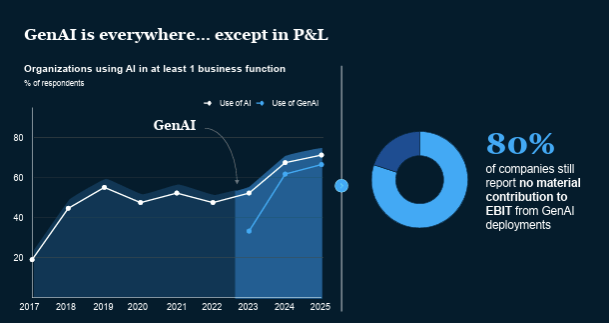
This week we read into the uncomfortable truth McKinsey dropped this week: 80% of companies still can't point to AI contribution to the bottom line.
AI continues to be theoretical for most enterprises but the shift from chatbots to agents might finally change the math. We also report on A16Z;s breakdown of why selling AI is nothing like selling SaaS, and Menlo Ventures makes the case that security's $200B+ incumbents are about to get disrupted by AI employees.
Let’s dive in
Source: McKinsey
The GPTLDR
McKinsey estimated GenAI could unlock up to $4.4 trillion in value, with 80% coming from four functions: sales and marketing ($1.2T), software engineering ($1.2T), customer operations ($0.4T), and product R&D ($0.4T) but enterprises are still not reporting any material impact to the EBIT from AI.
Their diagnosis is that first-generation GenAI tools are reactive, isolated from enterprise systems, and single-task focused. The solves comes from agentic AI that operates proactively across complex, multi-domain workflows.
The Details
Productivity Gaps: Individual augmentation delivers 5-15% productivity gains. Task automation pushes to 20-40%. Domain automation reaches 30-50%. But end-to-end journey automation? That's where 80%+ productivity potential lives.
Custom Built vs. Off-the-Shelf: More than 50% of AI's value is expected to come from custom solutions built and enabled by agents not off-the-shelf horizontal apps.
Compliance and Talent Risks: Approximately 40% of companies are not aware of GenAI risk, panning regulatory compliance, environmental impact, interpretability, and talent concerns.
What Matters
For CEOs/CFOs: The P&L impact gap isn't a technology problem—it's an organizational design problem. "Rewiring" organizations is likely the way to scale AI.
For CHROs: The workforce will become hybrid, changing all jobs, organizations, and processes. This isn't a tech transformation—it's a workforce transformation that requires HR leadership.
For CIOs/CTOs: Agent mesh frameworks, orchestration, and risk management are critical to succeed.
Start planning your multi-agent architecture now.
The GPTLDR
If you're buying or building AI products, the traditional enterprise sales motion is dead. In a recent a16z enterprise survey, 70% of buyers reported that speed of deployment was a top factor when engaging AI vendors. The implication: whether you're a buyer or seller, the playbook has fundamentally changed.
The Details
Buyer Behaviour Changes: Buyers are self-educating, demanding proof of ROI in demos (not POCs), and expecting outcome-based pricing. Buyers want to try AI now, not next quarter. Long sales and implementation timelines are no longer acceptable.
Results = Trust: Trust used to mean "we log what humans do on our software." Trust now means "we do the work correctly and can show how."
Demos Win in GTM: Demos are taking over the traditional POC role. The best teams prove their products work from the very first sales meeting.
What Matters
For Buyers: Set aggressive deployment timelines and ROI expectations upfront. If a vendor can't demo value in the first meeting with your actual data, they probably can't deliver it in production.
For CROs/CSOs: Your GTM team needs a technical upgrade. The best go-to-market teams look a lot like the best product teams: fast, technical, and obsessed with customers.
For CFOs: Outcome-based pricing models are gaining traction. Negotiate contracts that align vendor incentives with your actual results.
The GPTLDR
With 4.8 million unfilled cybersecurity positions globally and AI accelerating attack generation by close to 100x, the industry faces an existential scale challenge that only autonomous AI can solve. Menlo Ventures argues that legacy security vendors are structurally unable to adapt, creating a once-in-a-generation opportunity for AI-native startups to disrupt incumbents across EDR, SIEM, vulnerability management, and SOC operations.
The Details
Scaling Issues: Human analysts triage approximately 50 alerts per day, while AI has accelerated the pace of attack generation by close to 100x. One in five S&P 500 companies suffered major disruptions due to vendor failures in 2024
Slow Adaptation: Legacy platforms take 12- to 24-month implementation cycles and create lock-in and technical debt.
What Matters
For CISOs: Your stack was built for human-scale threats. AI-powered attacks now compress weeks of work into hours.
For CFOs: Evaluate AI-native vendors with outcome-based pricing—the "per-seat" model doesn't fit autonomous security.
For CEOs: As organizations deploy thousands of AI employees, traditional security models face an exponential increase in non-human identities that existing tools cannot monitor effectively.
Earn a master's in AI for under $2,500
AI skills aren’t optional anymore—they’re a requirement for staying competitive. Now you can earn a Master of Science in Artificial Intelligence, delivered by the Udacity Institute of AI and Technology and awarded by Woolf, an accredited higher education institution.
During Black Friday, you can lock in the savings to earn this fully accredited master’s degree for less than $2,500. Build deep expertise in modern AI, machine learning, generative models, and production deployment—on your own schedule, with real projects that prove your skills.
This offer won’t last, and it’s the most affordable way to get graduate-level training that actually moves your career forward.
📚 Interesting Reads
Google published five new guides on building AI agents:
Intro to AI Agents: The five levels of agent autonomy, from basic reasoning to self-evolving systems, plus architectures that actually scale.
Agent Tools & Model Context Protocol: How to design tools, implement MCP, and lock down security before agents start adding capabilities on their own.
Context Engineering & Memory: Build memory systems that curate context intelligently, so your agent stops treating every conversation like a first date.
Agent Quality: Why traditional QA breaks down for agents, and a four-pillar framework (effectiveness, efficiency, robustness, safety) that doesn't.
Prototype to Production: The trust-building playbook for moving agents out of the sandbox: CI/CD pipelines, guardrails, and scalable infrastructure.
➜ Until Next Week
The gap between AI's potential and its P&L impact isn't closing because of better models—it's closing because enterprises are finally learning to rewire themselves around agents, not chatbots. Whether you're buying AI, selling AI, or defending against AI-powered threats, the rules have changed. The companies that figure out the organizational design problem, will be the ones who win.
Stay curious,
—The GPTLDR Team
AI, simplified for Decision Makers.